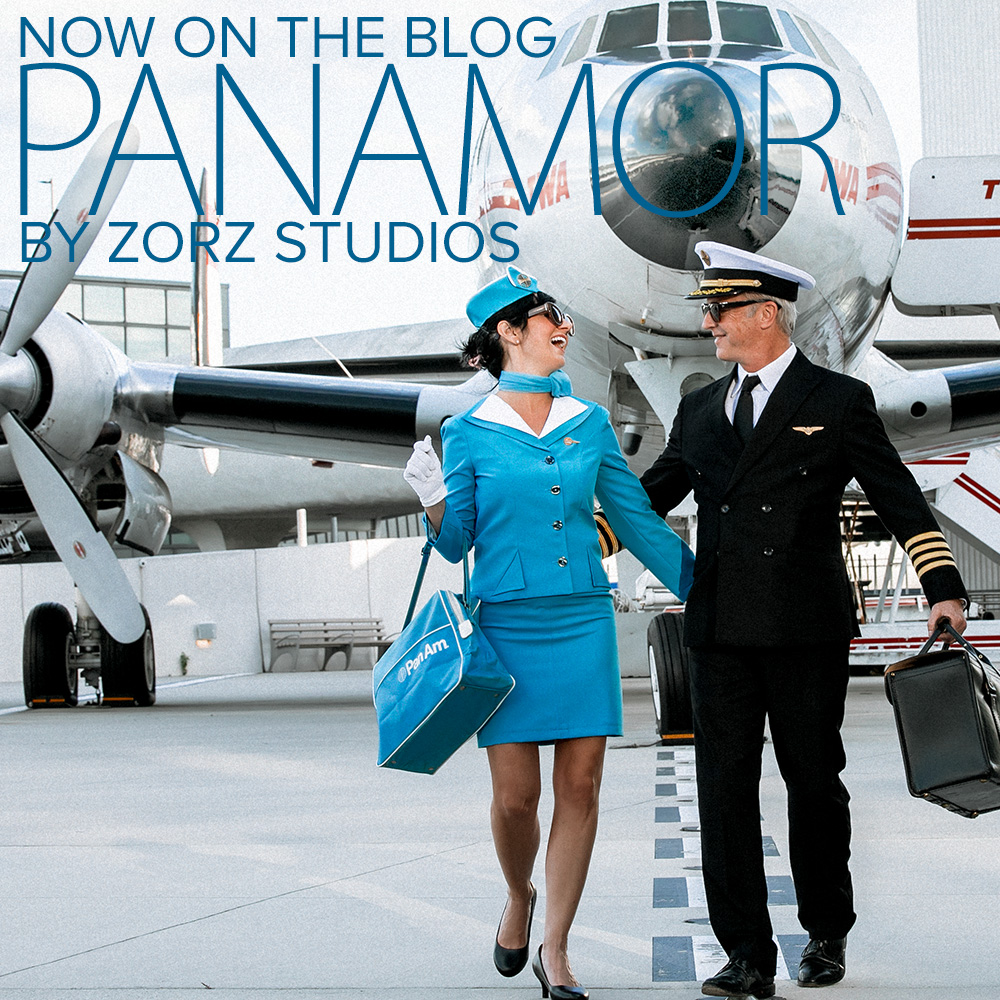
A TWA Hotel photoshoot had been sitting on my creative wish list since 2020, when another couple planned one and the pandemic killed the idea before it ever took off. Six years later, Charles and Barbara brought it back in full Pan Am style, complete with vintage pilot and flight attendant uniforms, luggage, and plenty of attitude. We had just 90 permitted minutes to work with, so I came early, scouted the hotel, mapped out the order, and then we went hard.
This story is part romance session, part time travel, and part practical guide for anyone planning to shoot there. Come for the photos, but stay for the tips, rules, locations, parking shock, and everything I learned squeezing as much as possible out of those 90 unforgettable minutes.
Table of Contents
Six Years Late
My first TWA Hotel photoshoot was supposed to happen in 2020. A couple who had won my EngagEd contest wanted to fly from Miami to New York for a travel-themed engagement session at the then-new TWA Hotel. Then COVID came along. Their wedding moved, plans kept shifting, and both the engagement session and wedding eventually disappeared from my calendar.
Then Charles found Zorz Studios through an online search in July 2026. His message was almost suspiciously perfect for me: he and his wife, Barbara, enjoy dressing for occasions and recreating period photography. For this one, they had vintage 1970s Pan Am pilot and flight attendant uniforms and wanted promotional-style photographs at the TWA Hotel, mostly for their own amusement and collection. They had recently done another period session aboard the Queen Mary in Long Beach, California, and sent me a few photos from it before we met.
And yes, they are married. During our session I saw other photographers working with engaged couples around the hotel, which makes perfect sense. But an engagement is not a requirement for a TWA Hotel photoshoot. Charles and Barbara simply wanted a fun date, a great set of photographs, dinner, and a night at the hotel. Married people are still allowed to do cool things together, like this Christmas adventure or this stunning mermaid-theme shoot in Jamaica.
So I called this one PanAmor: Pan Am plus amor.
TWA Hotel Photoshoot Rules
This is the part I would read before buying outfits or booking a photographer.
The TWA Hotel currently requires professional photo and video shoots to be arranged in advance with its Sales team and covered by a signed agreement. The hotel also requires a DayTripper reservation or an overnight stay to confirm a professional shoot, and its FAQ specifically says unauthorized engagement shoots are prohibited. Charles and Barbara were staying overnight, which also gave them a private room for changing and storage.
If you use a DayTripper stay instead, the hotel currently books those for a minimum of four hours. The reservation is nonrefundable, so coordinate the photography approval with the hotel before locking yourself into the rest of the plan. Weddings, corporate events, or commercial filming can affect shoot availability on a given date. Check the hotel’s current photography policy before making plans.
Our pass gave us 5:00 to 6:30 PM. Ninety minutes.
It allowed photography in the lobby, Flight Tubes, Sunken Lounge, Ambassadors Club, Twister Room, and seasonal activation spaces. The Connie cocktail lounge, Paris Café, Lisbon Lounge, Event Center, rooftop, elevator landings, and other guest areas were off limits for the shoot. TWA’s public FAQ also says rooftop tripods and gimbals need prior written approval, so do not build a rooftop setup into your plan unless your own agreement allows it.
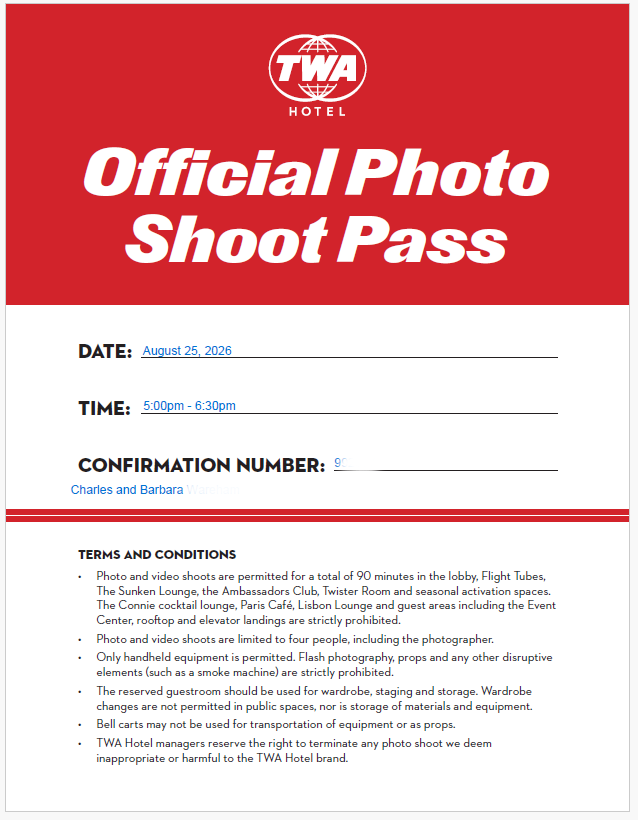
There were more restrictions worth knowing. Our permit limited the entire group to four people including the photographer. For a couple, that leaves room for only one additional person, so an assistant, second photographer, makeup artist, or friend can change the math quickly.
Only handheld equipment was allowed. Flash, smoke machines, props, and other disruptive elements were prohibited. Wardrobe changes, equipment storage, and staging had to happen in the reserved guestroom, not in public spaces. Bell carts could not be used to move equipment or become props. TWA management also reserved the right to stop a shoot it considered inappropriate or harmful to the hotel brand.
I am sharing our actual pass with this story because a real permit is more useful than vague Internet advice. I would still check the current rules before your own TWA Hotel photoshoot. Policies, spaces, and pricing can change.
One small lesson for photographers: before I saw the final permit, I had suggested period accessories. Once the written rules arrived, the no-props language took priority. Charles and Barbara already had their travel bags as part of what they were carrying, but I would not show up with a trunk full of suitcases, fake newspapers, lights, or set pieces and assume they are okay. Ask first.
The JFK Maze
I wanted to be early. Good decision, because getting to the hotel by car was the first challenge.
With JFK construction in full swing, I missed the TWA entrance… twice! At a normal building, missing a driveway means a U-turn. At JFK, it means another long loop around airport terminals while the clock keeps moving. I found it on the third try and still arrived early enough to scout.
The hotel is connected to Terminal 5, not Terminal 1. TWA’s current directions tell drivers to follow signs toward Terminal 5 and the hotel. If you arrive by AirTrain, get off at Terminal 5. You can walk indoors through JetBlue baggage claim, take the TWA elevator, and enter through one of Saarinen’s red-carpeted flight tubes. The AirTrain ride between JFK terminals and TWA is free.
For a timed TWA Hotel photoshoot, build in more arrival time than you think you need. That buffer is part of TWA Hotel photoshoot planning, not wasted time. The couple should already be dressed, or have enough room time to get dressed before the permit starts.
The photographer should scout first.
Once Charles and Barbara appeared in uniform with the pass active, I did not want to spend ten minutes deciding where to begin.
How We Flew
Start With The Board
We started where the building announces itself immediately: the huge arrivals and departures board.
The Solari split-flap board is mechanical, manufactured by Solari di Udine, and sits over the main terminal with all the visual authority of an airport scene from another era.
This was the cleanest place to establish our little fictional airline campaign. First, the formal crew portraits. Then a wider view with the board and terminal furniture. Then —movement and interaction.
Charles and Barbara could look polished in one frame and start laughing at each other in the next. I wanted both!
That became the rhythm of the whole TWA Hotel photoshoot: use the building for the period look, but do not let the couple turn into mannequins (or did I once?). The uniforms and architecture already do plenty of historical work. A glance, a hand on an arm, a laugh between poses, or simply walking with their bags kept the series about Barbara and Charles.


Curves And Clocks
From there we moved through the white stairways, railings, sweeping walls, red carpet, giant TWA letters, and that wonderful hanging Vulcain clock.
Eero Saarinen’s Flight Center opened in 1962, and the architecture gives you an unusual advantage: you can make a couple large in the frame, then step back and let those curves take over without changing locations.
I used the stairs several ways instead of treating each one as a new stop. Walking. Standing. Separation across the railing. A quick bit of teasing under the clock. A kiss. Low angles to stretch the architecture above them. Wider frames where they became small figures inside all that white space.
That is one way to make 90 minutes look much longer in the final gallery.
Do not measure variety only by the number of locations. Change distance, height, direction, body language, and whether the couple is performing for the camera or paying attention to each other.
The bright Pan Am blue against TWA’s white-and-red interior did me a favor all afternoon. Barbara could be tiny in a wide architectural frame and still pull your eye immediately. Charles’s black captain uniform gave the pair a clean visual anchor.


Sit Down A Minute
An intense session needs a change of pace before everyone starts looking as if they have been sprinting through an airport, and the lounge seating gave us that pause without wasting it.
We worked around the red seating, windows, and nearby uniform displays (here are the mannequins!). One of my favorite visual jokes from the day was a Pan Am crew wandering through a museum full of TWA history.
The hotel’s museum exhibits include authentic uniforms, travel posters, airline service pieces, furniture, and other artifacts curated with the New-York Historical Society. They are free and spread throughout the former terminal.
Sitting also let Charles and Barbara stop “performing” the airline roles for a minute. They leaned into each other, talked, kissed, looked out toward the tarmac.
One silhouette against the windows stripped away most of the period details and left two recognizable shapes.
For clients, this is worth remembering: a TWA Hotel photoshoot can be physically tiring. You are walking, climbing stairs, repeating movement, holding posture, carrying bags, and staying camera-ready while a photographer is watching a clock.
Choose shoes you can realistically stand and walk in for 90 minutes. A hotel room is useful for much more than satisfying the photography policy.


Small Stops
Then came the little places that make TWA dangerous to a photographer with limited time. Everywhere you turn, something says, “Photo op!”
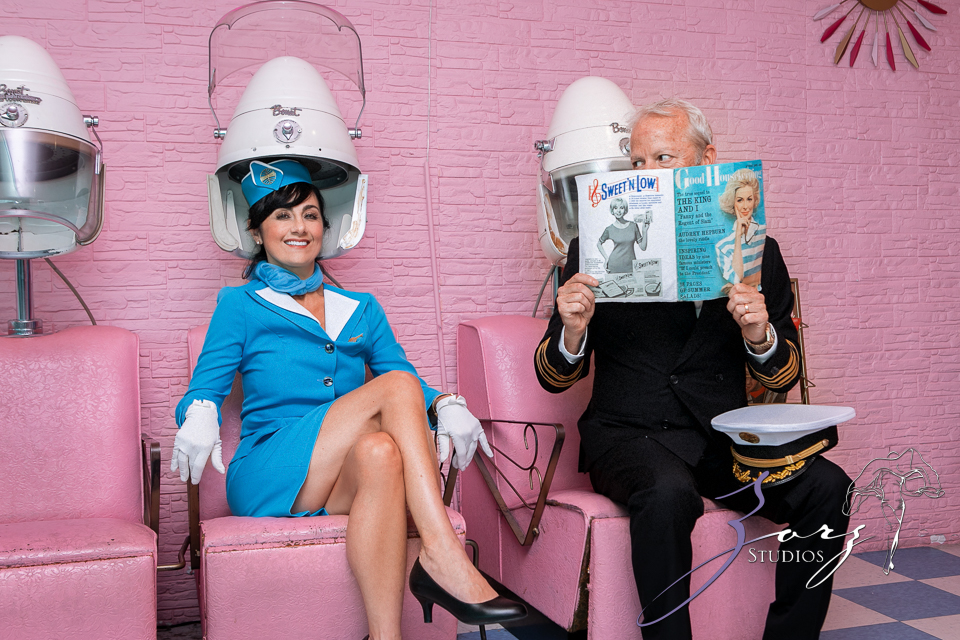
The Sweet’N Glow Salon was one of them. Pink walls, hood dryers, mirrors, retro magazines. Barbara sat under the dryer while Charles hid behind a magazine, then they started laughing in the mirror.
A few steps later, vintage pay phones gave us another quick scene. Barbara on one phone, Charles on another, then both of them breaking character because the whole setup was ridiculous in the best way.
These short stops are quite helpful, because you can get a very different picture without walking to the opposite side of the property.
The trick is not to photograph every cute object you see. A TWA Hotel photoshoot rewards quick decisions. There is a photo booth, Twister Room, museum material, vintage cars, flight tubes, lounge corners, signs, clocks, furniture, and more.
If you stop at all of them, the hotel will win and your 90 minutes will disappear…


Meet Connie
Then we jogged outside.
Connie is a 1958 Lockheed Constellation L-1649A, 116 feet long with a 150-foot wingspan, restored in TWA livery and parked beside the hotel as a cocktail lounge. The airplane itself had a long history with TWA before later jobs and eventual restoration.
For photography, the useful fact is simpler: it is enormous, strange, elegant, and impossible to fake. This is where the TWA Hotel photoshoot shifted from stylish terminal portraits into something that looked like a lost airline ad campaign.
We started with Barbara and Charles walking toward me beneath Connie’s nose. Then I changed scale: full airplane, nose, propellers, landing gear, wheels, stairs, tighter couple frames, kisses, salutes, and poses that let Barbara step forward while Charles followed behind.
A few yards can change a propeller from a distraction into a frame. A low position can make the boarding stairs cut diagonally through the photograph. Step back and suddenly the couple becomes the crew arriving for duty. Come closer and the rivets, wheel, or propeller make the scene feel tactile.
Our permit specifically prohibited the Connie cocktail lounge, so we did not build the shoot around its interior. The boarding stairs and exterior gave us more than enough. The Connie Cocktail Lounge currently opens at 4 PM, but opening hours do not override your photography agreement. Treat the permit as the authority for your session.


Last Light
By the end, the energy changed. The polished airline-ad poses loosened, the sun dropped behind the terminal, and Charles and Barbara had already done enough… The last frames are quieter, with warm sun cuts across the building. They stand together with their bags, less concerned about playing captain and flight attendant and more obviously themselves.
Six years after my first planned TWA Hotel photoshoot vanished, I finally got one.
Perfect landing, guys.


Know What To Skip
I had more ideas… I wanted to get Charles and Barbara with the retro cars. We ran out of practical time, and by then they were tired. We had pushed hard for roughly 90 minutes and slipped perhaps 10 to 15 minutes past our scheduled end.
I did not feel that anyone was standing over us with a stopwatch, and nobody appeared at 6:30 to escort us out. I would never plan around that. Luck varies, staff changes, and the pass still said 90 minutes.
So, we stopped. Charles and Barbara had a dinner reservation at the Paris Café by Jean-Georges inside the hotel, and they had already given me plenty from their TWA Hotel photoshoot.
And again, you do not need to be engaged. Charles and Barbara have been married long enough to know exactly what entertains them, and one of those things is dressing up and making period photographs together. That sounds like a perfectly good reason for a romance session to me, like many couples in this portfolio of mine!
Make 90 Minutes Work
If I were planning another TWA Hotel photoshoot tomorrow, I would keep the same basic logic: scout without the couple, start with the main terminal, work outward in one direction, save the airplane for later light, and leave a small buffer for something unexpected.
For a 5 PM start, I would think roughly 20 minutes around the board and main terminal, another 20 around the stairs and lounge, 10 to 15 for small exhibits and phone booths, then 30 or so around Connie, with whatever remains used as a safety margin.
That is not a required route. Light, crowds, restricted spaces, hotel events, and your couple will change it. The useful part is deciding the order before the permit clock begins.
The huge windows give you a lot of natural light. A versatile zoom or two bodies with complementary lenses can save time over constant lens changes. Wide angles help with Saarinen’s architecture; normal and short telephoto focal lengths keep the couple from getting lost inside it. Outside, a longer lens can simplify backgrounds when tourists or other photographers enter the scene.
For clients, a TWA Hotel photoshoot goes smoother when wardrobe gets the same planning. Structured clothing works well because the building has such clean lines. If you are going for a period theme, remove modern interruptions: smart watches, fitness trackers, contemporary backpacks, neon sneakers, giant phone cases.
Barbara and Charles committed all the way down to hats, gloves, bags, and shoes, which is why the fantasy survives close inspection.
Do the wardrobe changes before the permit starts whenever possible. If you need two looks, I would decide whether the second outfit is worth the time it will steal from photography.
Crowds also need a strategy. Other photographers were working while we were there. Rather than waiting forever for a sterile background, I changed angles, used architectural walls to block people, shot tighter when needed, and moved on. Some locations will clear for a few seconds if you are ready.
Other photographers who shoot here recommend early morning for fewer people; late afternoon is often better for directional light. Our 5 PM TWA Hotel photoshoot gave us some traffic inside, but it also paid us back with that warm light outside at the end.
Edit The Era
The period look does not end when the camera goes back in the bag.
A generic “vintage” preset can easily turn a careful 1970s concept into orange shadows, gray blacks, fake light leaks, and random scratches. I wanted the finished TWA Hotel photoshoot to feel closer to period airline advertising and transparency film than a social-media retro filter.
For photographers chasing a similar result, Kodak Ektachrome and Kodachrome are better references than simply searching for “vintage.” Keep the color recognizable. Let reds and blues stay useful. Soften the hyper-digital edge a little, and use grain with restraint.
The uniforms, Connie, furniture, clocks, phones, and Saarinen architecture already tell viewers which decade they are visiting. The processing does not need to shout over them.
Parking Reality
One final practical surprise: parking.
I had budgeted travel for gas and tolls and did not expect a short visit to hurt. My card was charged $66.23 by the TWA Hotel parking garage. I was there roughly two hours, although scouting before the session and going a little over the permit window obviously added time. I sent the receipt to Charles afterward because this was not a small expense to quietly absorb.
As of September 2026, TWA’s dedicated parking page lists valet at $45 for up to two hours, $60 for up to four hours, and $80 daily, with rates subject to change. The hotel currently offers valet only, no self-parking. Paris Café patrons can currently get a $20 two-hour parking rate by showing their restaurant receipt.
Check that live parking page before your TWA Hotel photoshoot rather than trusting an old photography blog that still quotes much cheaper rates (I’ve seen $10).
If you do not need to drive to the front door, consider the AirTrain and Terminal 5 route. TWA’s directions say the hotel is accessible from the Terminal 5 AirTrain stop, and you can also walk indoors from JetBlue’s baggage claim through the TWA elevator and flight tube.
Credits
- Venue and photoshoot location: TWA Hotel (@twahotel)
- Dinner: Paris Café by Jean-Georges (@jgrestaurants)
- Photography and creative direction: Zorz Studios (@zorzstudios)