16 hours, one wedding, two cultures, three spontaneous “sure, why not?” challenges. What started as a regular Indian-Chinese wedding spiraled into a whirlwind of drone flights, live streaming, and a full same-day edit I had never attempted before—all by myself. By midnight, my heart was somewhere between exhaustion and euphoria. If you’ve ever wondered what it’s like to film, edit, and premiere a wedding movie in a single day while juggling every possible curveball, this one’s for you.
Table of Contents
I’ve filmed a lot of high-energy, cross-cultural weddings, but this was my first same-day edit. Alison and Kristofer’s Indian-Chinese celebration came to me through the groom’s mom, Deepali, who led much of the planning (at least on my end). Her family is Krishnaite, and if you’ve followed my work, you might remember her cousin Radhika’s events I filmed: a three-day Gujarati wedding and, later, her playful baby shower. The same family, the same warmth, the same temple community, and a new challenge for me: create a film in the morning, then premiere it that evening.
When “Sure, Why Not?” Becomes a Motto
Originally, there was supposed to be another Zorz Studios videographer on this wedding, since I was already booked for another event that same day—a detail I made sure the family knew early on. Then, a few months before the wedding, that other one was cancelled, freeing me up completely, much to their delight.
From there, things escalated in the best way. They asked if I could add a drone—usually a second videographer’s job—but I said yes. I like challenges, and I like saving my clients from unnecessary add-ons. Then came another curveball: could I live-stream a special dance performance? I’d never done it myself, but I signed up. And when the same-day edit idea landed on the table, I said yes again. What can I say? I love this family, and they seem to know exactly how to keep me on my toes. 🙂
First-Time, Not First Rodeo
While this was my first same-day edit, it didn’t feel foreign. I’ve been assembling post-wedding highlights for years and jumped into new territory before with great results—underwater portraits come to mind. The blueprint doesn’t change: prepare, believe, stay calm. Swapping a long post window for a six-hour sprint sounds scary until you’ve got a template project, a well-chosen track, and a simple system for capturing and finding moments. Then it’s pure storytelling with a timer running.
The Setup: Two Venues, One Goal
Friday was the Viddhi at ISKCON Central NJ. I photographed it. Saturday moved us to Bridgewater Marriott, where everything for the wedding day lived: getting ready, first look, baraat, puja, ceremony, portraits, reception, and most importantly, my impromptu edit bay.
Deepali booked an extra two hours for morning preps as an add-on. I started coverage at 8 AM, but arrived at 7 to scout drone paths, find a safe launch/landing zone in the parking lot, and pick a quiet corner I could convert into a tiny post-production bunker. I wanted power, table space, Wi-Fi, and a clear path to run back and forth. That corner became mission control.
I was solo, bouncing between the bride’s and groom’s rooms, then documenting a first look that had to hide from the swarm of hotel guests. The place was packed, so the background wasn’t the dreamy garden we’d love—picture a highway peeking through. See that semi-truck barging into their kiss? Real life beats ideal settings when the schedule is tight. We made it work and kept moving.
Baraat, Cadillac, Drone
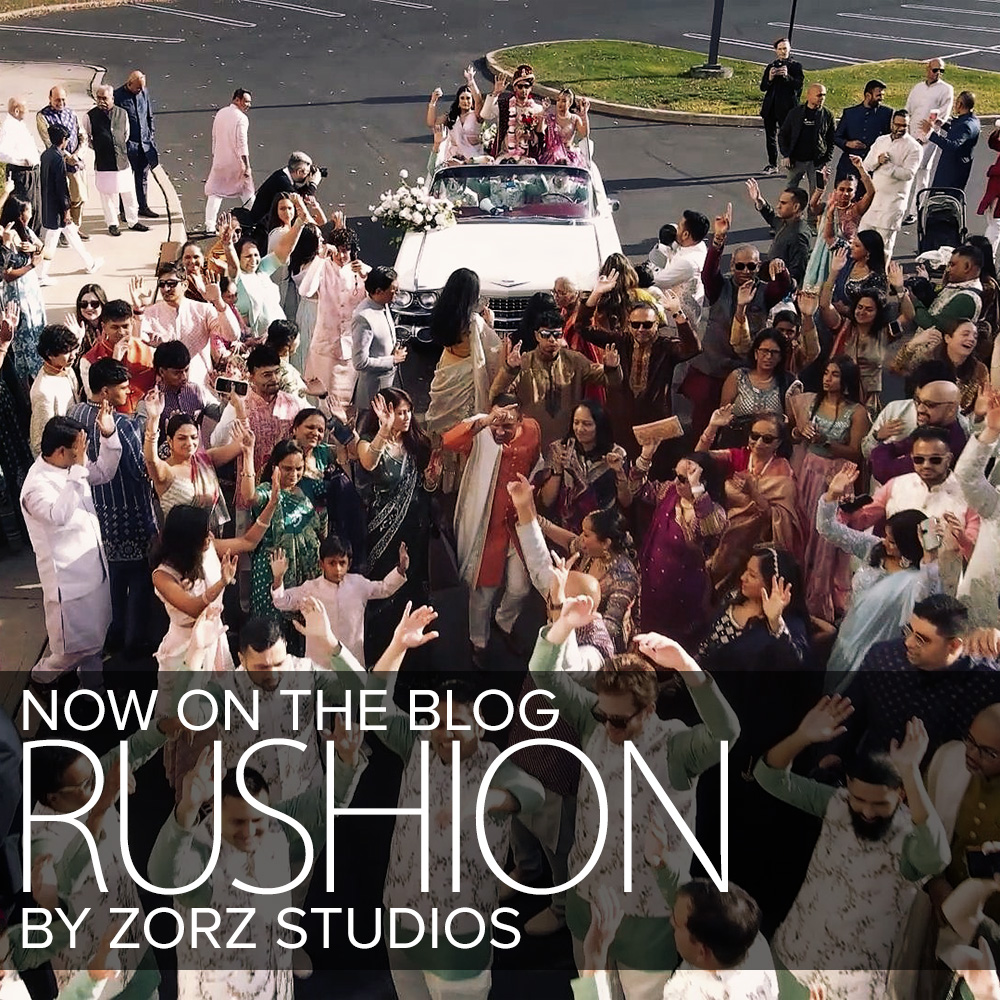
The baraat took place in the lot, trailed by a classic white 1959 Cadillac 62 Series Convertible. That car had presence. I sprinted ahead to get clean plates of the vehicle before the crowd closed in, launched the drone, arced around the Caddy, then dove back into ground coverage of insane dancing and arrivals. Backpack stayed on the whole hour. If you’re imagining me jogging with a rig and a stuffed pack while glancing at wind speed, you’ve got the picture.
Drone landed, handheld back up, and we were into the puja and ceremony. After the ceremony came family portraits—about 40 groupings, pre-organized on cards, which saved time and headaches. That’s when the switching started: mandap for key moments, laptop for offloading. I ended up ingesting over 500 clips on the fly. Then the vidaai and a final farewell to the Caddy.
I offloaded one last card, dropped into my corner, and plugged into the same-day edit.
My Same-Day Edit Workflow
In a Nutshell
- Ingest as you go. Between ceremony beats I was offloading cards. Keep a clear folder structure and don’t overthink bin names—speed first.
- Drop the anchors. Place your opener, ceremony peaks, couple reactions, and vidaai near the natural phrasing of the track.
- Fill the bridges. Use preps and first look to build the first third, baraat for the second third’s surge, then rituals and family to carry the emotional core.
- Micro-passes. First pass for narrative order, second pass for trims, third pass for rhythm.
- Titles last. The opener and closer are pre-built, so you just update names and colors, proof, done.
- Export 1080p. It’s quick, reads well on ballroom screens, and is merciful to laptops that just sprinted a marathon.
Gear and Station
- Mirrorless body with stabilized lens
- Drone with ND handy and a pre-approved flight plan
- Fast UHS-II cards
- Lenovo Legion Pro 7i laptop with internal SSD and enough headroom for an hour of 1080p proxy or native cuts
- Wired mouse, noise-cancelling headphones (see “What Went Wrong” below)
- Dual-slot reader
- Two small extension cords, a short power strip
- Mini clamp for a phone if you want a BTS time-lapse
- Gaffer tape and a printed “editing in progress” note
Pre-Game Matters: Why the SDE Worked
The only reason this was feasible: preparation. Before leaving my office, I picked a licensable song that fits strict same-day edit criteria. Here’s what I look for and what I recommend to other starting filmmakers:
- Tempo variety within a single track so I can pivot through moods: prep, energy, ritual, emotion, and exit without changing songs.
- BPM around 100 works great—steady enough to cut to, not dragging, not frantic.
- Cultural theme that matches the day. I leaned Indian, because convincing Indo-Chinese fusion tracks are rare.
- Legitimate license ready to go. Do not add legal worries to an already intense timeline.
I also built a template project before I left. That’s a life saver:
- Beat mapping across the whole timeline. I marked downbeats and phrases so I could drop moments on rhythm without thinking.
- Pre-built opener with the couple’s names and wedding colors.
- Pre-built transitions for each stage (preps, first look, baraat, puja, ceremony, portraits, vidaai).
- Pre-built closing card for an elegant credit.
That template easily saved two hours. The goal wasn’t to overdesign the film, it was to create a runway where I only focus on selection and storytelling: scan hundreds of clips, choose what matters, sequence it to music, and export.
Practical Music Notes for SDEs
Because folks will ask, here’s what I screen for when picking an SDE track:
- Intro that reads: space for names and an establishing sequence
- Verse for preps: low-stakes, human details, anticipation
- Lift for first look: small dynamic rise without peaking too early
- Chorus for baraat: the big energy moment that can carry dancing and arrivals
- Bridge for rituals: a respectful contour that sits under sacred actions
- Final lift for portraits to vidaai: warmth, then closure
- Clean outro: one beat or swell to land the closing card
If the track has those shapes, you can map a wedding day without ever swapping music mid-edit.
What I Remembered While Shooting (And How)
You can’t scrub through two hours of raw footage during an SDE. You need ways to mark highlights in the moment so you can find them later:
- Mental timestamping: glance at the time when a moment happens, then jot “10:24 bride hugs papa” in your phone’s notes.
- In-camera rating/flagging: if your camera supports it, star the clip or lock it.
- Clip handle trick: roll a few seconds longer and briefly point down to your shoes or whip-pan at the end. It creates a visual “flag” in the thumbnail strip.
- Voice memo: while walking to the next room, record a 10-second note, “after baraat: couple stepping on, mom putting bindi.”
- Shot list markup: keep a micro shot list on index cards and scribble a dot next to must-have moments as they happen.
I used a mix of these across the day. Even the simple “mental timestamp plus two words” method is gold at SDE speed.
Why a Single Camera Was Enough for SDE
For same-day edit specifically, I didn’t try to run a static second camera. Short, moving clips from one camera were ideal. They’re dynamic, they compress time, and they keep you free to chase moments. Syncing multi-cam under a hard deadline is a trap. If you need a second angle for safety, grab it handheld from a different height and cut to it when energy spikes.
Same-Day Edit Tips
- Use a mouse, ideally wired for zero lag.
- Wear noise-cancelling headphones and carry a tiny power bank.
- Don’t chase perfection. Aim for pacing and story.
- One camera is fine for SDE. Short, moving clips beat multi-cam syncing.
- Bring a small “Please do not disturb—editing in progress” sign for your table.
- Edit from an internal SSD and use a fast card reader.
- Export 1080p for speed and reliability on venue screens.
- Build a template project in advance: beats marked, titles set, transitions ready.
- Choose a licensable track with a 100 BPM neighborhood and mood shifts.
- Have highlight capture methods: in-camera flags, mental timestamps, voice memos.
- Optional: a drink, a small USB fan, two outlet splitters, and gaffer tape for cable sanity.
What Went Wrong (And How I’d Fix It)
- Touchpad lag: I don’t get that at the office. It showed up here under heavy scrubbing. A mouse makes a huge difference, and I’ll go further: I’m adding a wired mouse to my SDE kit so I never deal with Bluetooth hiccups during crunch time.
- Noise battle: I picked a quiet corner, but friends and family needed a place to rehearse dances (classic at South Asian weddings). They were super polite and asked first. I needed to hear the track. They needed space. My noise-cancelling headphones saved the day—after I charged them. Note to self: keep a small battery pack in the SDE pouch.
- Forgot BTS: I was so deep in the cut I didn’t snap behind-the-scenes visuals. Next time, I’ll set a phone on a mini clamp to time-lapse my station. Or I’ll hand a second phone to a trusted cousin for a few quick grabs.
The Premiere
I finished on time and delivered the file to the DJ booth. No break. As soon as I handed it off, I went straight back to cocktail hour coverage, then into reception. The SDE played early in the program once everyone was seated, with the couple centered so they could soak it in:
Client Reactions
Deepali sent this after the weekend:
One from Radhika:
And here’s a short clip of the couple’s reaction to this same-day edit. They unboxed it with some 330 guests, so the reactions are real.
Those compliments mean a lot, especially on a first SDE. Their package also includes a full-day highlights film, which I’ll deliver in the coming weeks.
Credits
Vendors and creatives worth a follow and a bookmark:
- Venue: Bridgewater Marriott (@marriottbonvoy)
- Henna artist: Ashlesha, Henna by Ash NJ (@henna_by_ash_nj)
- Priest: Arvind Maheta (@shastri_arvind_maheta)
- Bridal Makeup: Almari Beauty (@almari.beauty)
- Bridesmaids’ Makeup: Appease (@appease2you)
- Hair Styling: Jane Everwell Beauty Bar (@jane_everwell)
- Decor: Nirali Decor (@niralidecor)
- Catering: Moghul Catering (@moghulcaterers)
- Wedding Cake: Palermo Bakery (@palermos.bakery)
- Drummer: Om Bhatt, Premier Drummers (@premierdrummers)
- DJ: Sharad (@djsharad) of DJUSA (@djusaevents)
- Photography: Natasha Miller, Tashography (@tashography_)
- Cinematography and same-day editing: Ed Hafizov, Zorz Studios (@zorzstudios)