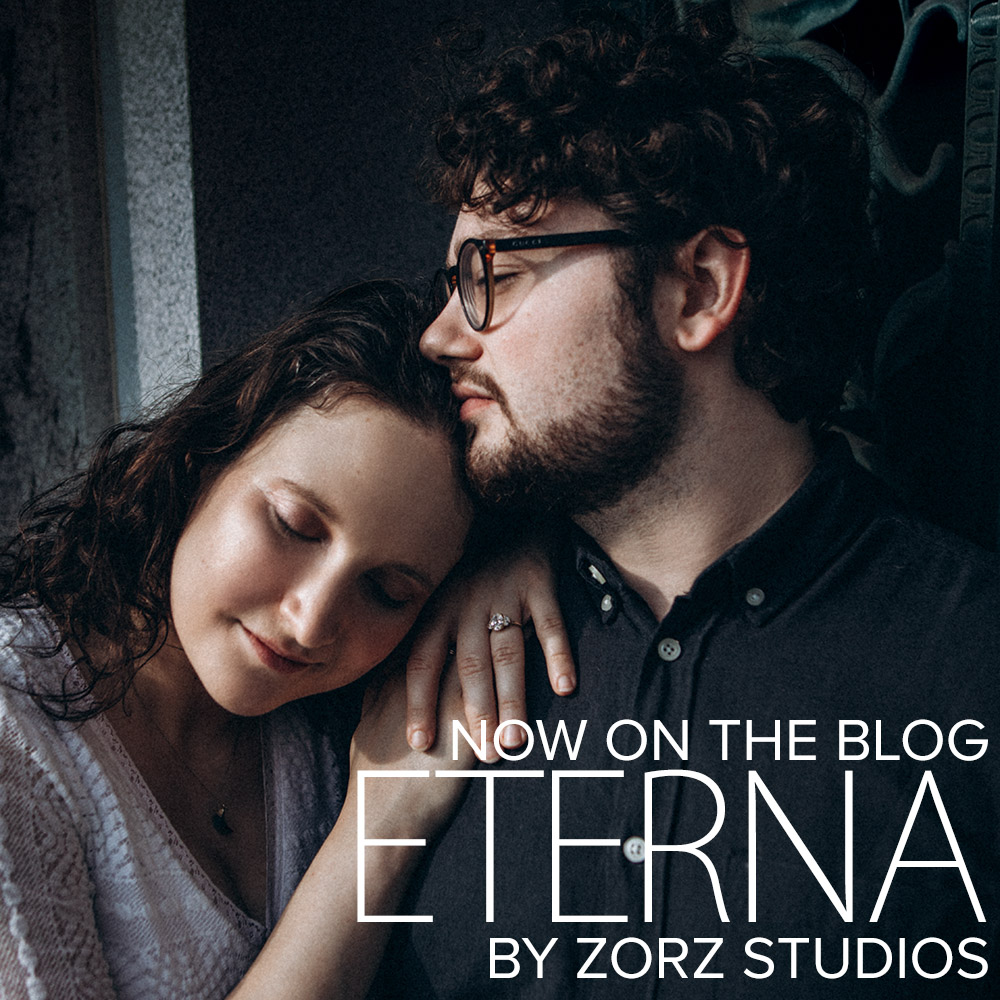
When you hear the words cemetery engagement session, you probably raise an eyebrow. And rightly so. Most couples don’t picture their love story unfolding among tombs and statues. I’ve photographed at cemeteries before, and covered Halloween weddings where I hoped the couples would take their engagement session into such a setting, but none did, until Dasha and Eric. And instead of Halloween theatrics or gothic posturing, their approach carried a subtler, more profound meaning. This was about love—alive, playful, and eternal—set against one of New York City’s most unexpected and beautiful backdrops.
Table of Contents
Why Green-Wood Cemetery?
Green-Wood Cemetery is no ordinary burial ground. Founded in 1838 as the third rural cemetery in the United States, it was part of a movement to create park-like spaces that combined remembrance with natural beauty. Long before Central Park existed, New Yorkers came here to breathe fresh air, picnic among the hills, and marvel at the art and architecture that dotted its rolling 478 acres.
Key milestones chart its journey from a quiet refuge to a cultural landmark:
- 1840: The first burials took place.
- 1883: The Brooklyn Bridge opened, bringing more visitors from Manhattan.
- 1966: Green-Wood was recognized as a New York City Landmark.
- 2006: It was elevated to National Historic Landmark status.
- 2015: Its vast tree collection was accredited as an arboretum.
Today, Green-Wood Cemetery proudly calls itself both a “rural cemetery to urban oasis” and “a living cemetery.” It’s a place where life and death coexist—not in opposition, but in dialogue. Thousands of migrating birds stop here each year. Pollinators find food in its gardens. People attend concerts, art exhibitions, historical tours, and even music festivals. To walk its paths is to walk through centuries of memory, yes—but also through a vibrant, evolving community.
Famous Names Beneath Its Soil
If you need convincing of its significance, just look at who rests here:
- Leonard Bernstein (1918–1990): the legendary composer and conductor.
- Samuel F.B. Morse (1791–1872): inventor of the telegraph and accomplished painter.
- Laura Keene (1826–1873): the actress performing onstage when President Lincoln was assassinated.
- Sarah Kairns (1737–1854): mother of 22 children, died at 117, the cemetery’s oldest resident.
- The Roosevelt Family Lot: including Theodore Roosevelt’s first wife and parents.
- Henry Bergh (1811–1888): founder of the ASPCA.
- Susan Smith McKinney-Steward (1847–1919): the first African American woman to earn an M.D. in New York State.
- Margaret Pine (1778–1857): born into slavery in Brooklyn, freed when slavery ended in New York in 1827.
- Do-Hum-Me (1825–1843): daughter of a Sac Native American Chief.
- Charles Feltman (1841–1910): the man credited with inventing the hot dog.
- James Renwick, Jr. (1818–1895): architect of Manhattan’s St. Patrick’s Cathedral.
That list alone illustrates how Green-Wood is less a “cemetery” in the narrow sense, and more a museum of human history spread across rolling hills.

Meeting Dasha and Eric
Dasha and Eric are not your average couple either. Their love story began by chance on the High Line in New York, where a conversation about art between two groups of friends led to a dinner, then dating, then—less than a year later—a decision to marry. There was no dramatic proposal. Instead, it was mutual clarity, with what they jokingly called a “cute incentive” for marrying sooner rather than later: Dasha’s pregnancy.
When we met over video to plan their wedding photography and videography (which Lara and I are going to cover this weekend!), I was charmed by their calm confidence. No bridal party, no elaborate traditions. Just a family gathering outdoors at a scenic property, with sparklers, a fire pit, and s’mores. It was the kind of celebration where the ceremony was heartfelt, but the atmosphere was relaxed.
Language would play a role—Dasha’s grandparents speak only Russian, her parents are bilingual, while Eric is learning. I assured them I’d make extra effort with her grandparents, both in directing portraits and in small gestures of inclusion.
Choosing Green-Wood for Cemetery Engagement Session
As we talked about the engagement session, they mentioned two meaningful places: the High Line (where they met) and Green-Wood Cemetery, where they had their first date (yeah!). The High Line was tempting (check out this action-packed family shoot I did there earlier this year), but Green-Wood won out for its uniqueness.
I explained the possibility of strict rules seen in some unique parks like Longwood Gardens: no commercial photography without permits, though cell phones are fair game (I had one anecdotal experience there for a commissioned family shoot forcedly made on a cellphone). Sometimes it takes discretion to make art where bureaucracy might frown. We agreed to try the cemetery first, ready with a backup if staff intervened. They didn’t—and we were able to create a set that surprised even me.
Cabeza de Mujer—From Bronze to Playfulness
One of the first stops was Javier Marín’s bronze sculpture Cabeza de Mujer (Sopladora Grande). The Mexican artist is known for monumental works that fuse pre-Hispanic forms with European baroque energy, often presenting fragmented human bodies on a massive scale. Here, the sculpture depicts a female head in mid-breath, lips pursed as if blowing. It is simultaneously classical and surreal—eternal stone made human.
I couldn’t resist mimicking it. Dasha and Eric leaned in, exaggerated lips, and transformed high art into humor. That mix—of reverence and play—set the tone for the shoot. Cemeteries are meant to humble us, but they also remind us not to take ourselves too seriously.

Romance in the Style of Paintings
For the cover image, I wanted more than a portrait—I wanted a painting brought to life. The way Dasha rests her head on Eric’s shoulder, her body leaning into his quiet strength, recalls the great canvases of intimacy and protection.
It’s the same tenderness captured in Pierre-Auguste Cot’s The Storm, where a young woman clings to her lover for shelter; in William-Adolphe Bouguereau’s Rest, with its serenity and trust; in Gustav Klimt’s The Lovers, where an embrace becomes eternal; and in Frank Dicksee’s Romeo and Juliet, the balcony transformed into sanctuary. Even Frederic Leighton’s Flaming June, though solitary, resonates through the repose of a figure at peace, her softness echoing in Dasha’s quiet surrender.
I feel like this photograph carries the spirit of those timeless works, a reminder that love has always been painted as both strength and refuge.

Power in the Glance
Stone arches, mausoleum walls, colonnades—these became backdrops where I asked them to simply look at each other. Sometimes the simplest gesture carries the most weight. A direct gaze, framed by massive architecture, feels both tender and monumental. Their connection became the focal point, while the cemetery’s grandeur reminded us of the scale of history they stood inside.


Candid Moments
Engagement sessions aren’t only about posed beauty. Some of my favorite moments were spontaneous—Eric lost in thought while Dasha adjusted her hair, a laugh after a silly prompt, the way her hand brushed his cheek. Even the stone inscriptions joined in, one reading “Love above all,” as if the place itself wanted to bless them. And when I asked them to be a little silly, they leaned right in—playful, lighthearted, and unafraid to show their joy against such a grand setting.


Nature’s Embrace
One of Green-Wood’s surprises is just how green it is. We shot near a reflective pool, a doorway framed by ivy, and tree-lined paths. In one image, water, wood, and stone layered around them until they seemed swallowed by life itself. It’s proof that cemeteries can be lush ecosystems, not sterile landscapes.


Sheltered in Each Other
The next four frames capture the softer heart of the session—the kind of intimacy that feels effortless.
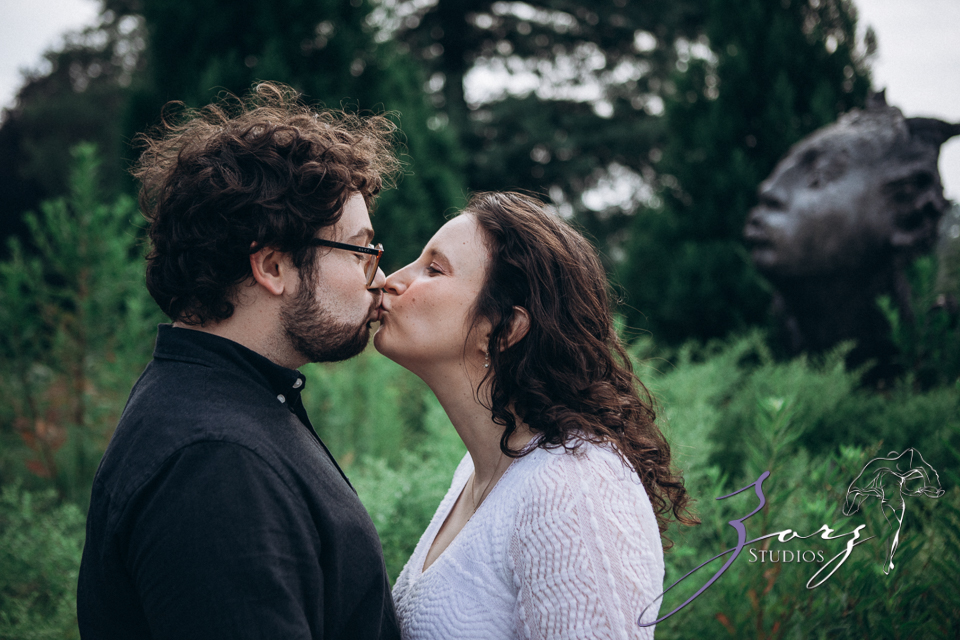
In one, Dasha leans into Eric’s embrace, her expression serene, almost dreamlike, as if the world fades around them. In another, they sit close against stone and tall grass, laughing with the kind of comfort that only comes from trust. A kiss shared on the path is unposed and grounded, sneakers and all, a reminder that love thrives in the everyday. And then, framed by Gothic spires and greenery, their kiss becomes something more timeless, as if the architecture itself rose up to honor them.
Together, these moments move between playful, tender, and iconic—proof that an engagement session can hold every shade of closeness.


The Weeping Beech Tunnel
Perhaps the most enchanting stop was the famous Weeping Beech Tunnel. A group of six European beeches have grown together into a cascading passageway of branches. It feels like stepping into a fairytale grotto—living architecture sculpted by time. For many visitors, it’s a favorite part of Green-Wood Cemetery. For us, it became a cathedral of leaves, where the couple’s quiet moments echoed the whispers of generations past.
This frame of Dasha looking upward might be my favorite from the entire shoot. It distills what I felt during this session—quiet strength, hope, and presence. It has little to do with a “cemetery engagement session” on the surface, yet everything to do with her.


The Tragedy of Charlotte Canda
Near the end, we paused by one of Green-Wood Cemetery’s most storied monuments: the tomb of Charlotte Canda. Charlotte was a beautiful young socialite who died tragically on her seventeenth birthday in 1845 when she was thrown from a carriage. Her fiancé, Charles Jarrett de la Marie, reportedly devastated by her death, was buried nearby a year later.
Charlotte, known for her artistic talents, had sketched ideas for a monument to honor her recently deceased aunt. After her sudden death, her father transformed that design into a personal memorial for her, weaving in symbols of who she was—her initials, musical and drawing instruments, books, and even sculptures of her beloved parrots. At its heart, a niche was created to hold a portrait statue of Charlotte herself, with a star above her head to represent immortal life.
The Canda family spared no expense. They hired John Frazee, a prominent New York architect and marble carver based on Broadway, to bring the design to life. Working with him was Robert Launitz, a Russian sculptor trained in Rome, who carved the statue of Charlotte. Together they created one of Green-Wood’s most intricate and celebrated monuments—delicate in detail, rich in symbolism, and enduring as a tribute to a young life cut short.
Being there, with Dasha and Eric leaning into each other, was like watching two living lovers in dialogue with a story of love cut short. A cemetery engagement session isn’t about anything grim—I’d say it’s about showing how love can stand right next to history, where the past and present naturally meet.


The Skyline and the Arch
Before we left, I captured them with Manhattan’s skyline faint in the background—a reminder of their urban roots. And finally, at the grand Gothic Arch, designed by Richard Upjohn and Son in the 1860s, we closed the circle. That arch, a New York City landmark, has greeted generations of visitors entering Green-Wood. For Dasha and Eric, it became their exit point, their portal back into the city with new memories carved into their story.


I’ll Be Recommending Green-Wood Again
I went into this session curious, cautious even. I’d photographed weddings and portraits in cemeteries before, but never engagements. It felt like a bold choice, and I thought of my Halloween wedding couples who never took that step. What Dasha and Eric did here was more meaningful. It wasn’t kitschy, it wasn’t obvious. It was thoughtful, tender, and unique.
Green-Wood Cemetery is a place where life and death meet without irony. Where birds migrate overhead, where artists install works, where concerts bring neighbors together. To photograph love here is to affirm that life persists, joy persists, connection persists. That’s what makes a cemetery engagement session so powerful.
Here’s why consider Green-Wood Cemetery for a photoshoot:
- Diverse backdrops in one place: grand Gothic architecture, lush greenery, historic sculptures, rolling hills, and even the Manhattan skyline.
- Vast grounds: space to explore and create without running out of ideas.
- A cultural and educational layer: every path tells a story through history, art, and the people resting there.
- Unique, not cliché: it doesn’t have the “yet another Central Park” feel—this is something truly different.
- No crowds: clear backgrounds, minimal interruptions, an atmosphere of calm.
- Easy logistics: move/drive freely across the grounds, free short-term parking anywhere, and the entrance sits right on a subway line.
- No permits required (for now): unlike many unique NYC spots, shooting here doesn’t involve red tape.
- Seasonal variety: spring blossoms, autumn foliage, winter stillness, and summer shade each offer their own charm.
- Respectful environment: the one tradeoff—come with mindfulness. This is a place of remembrance as well as beauty, so proper behavior is a must.
Dasha and Eric’s trust opened my eyes. This was quite an experience—one I’ll now gladly suggest to other couples who want to step beyond the expected. Because love, like Green-Wood itself, is both eternal and alive.
Looking forward to capturing their big day this Saturday!